
Why Paying for a Date Isn't Owed Sex: Reciprocity, Consent, and the Orgasm Gap
Quick summary: Paying for a date is not a fair trade for sex. Real reciprocity in dating and relationships is built through attunement, curiosity, and ongoing consent, not purchased with a dinner bill. This is especially common in heterosexual dating, where cultural and religious scripts have long treated sex as something owed rather than mutually chosen, and the same dynamic often continues into marriage as sexual coercion disguised as obligation.
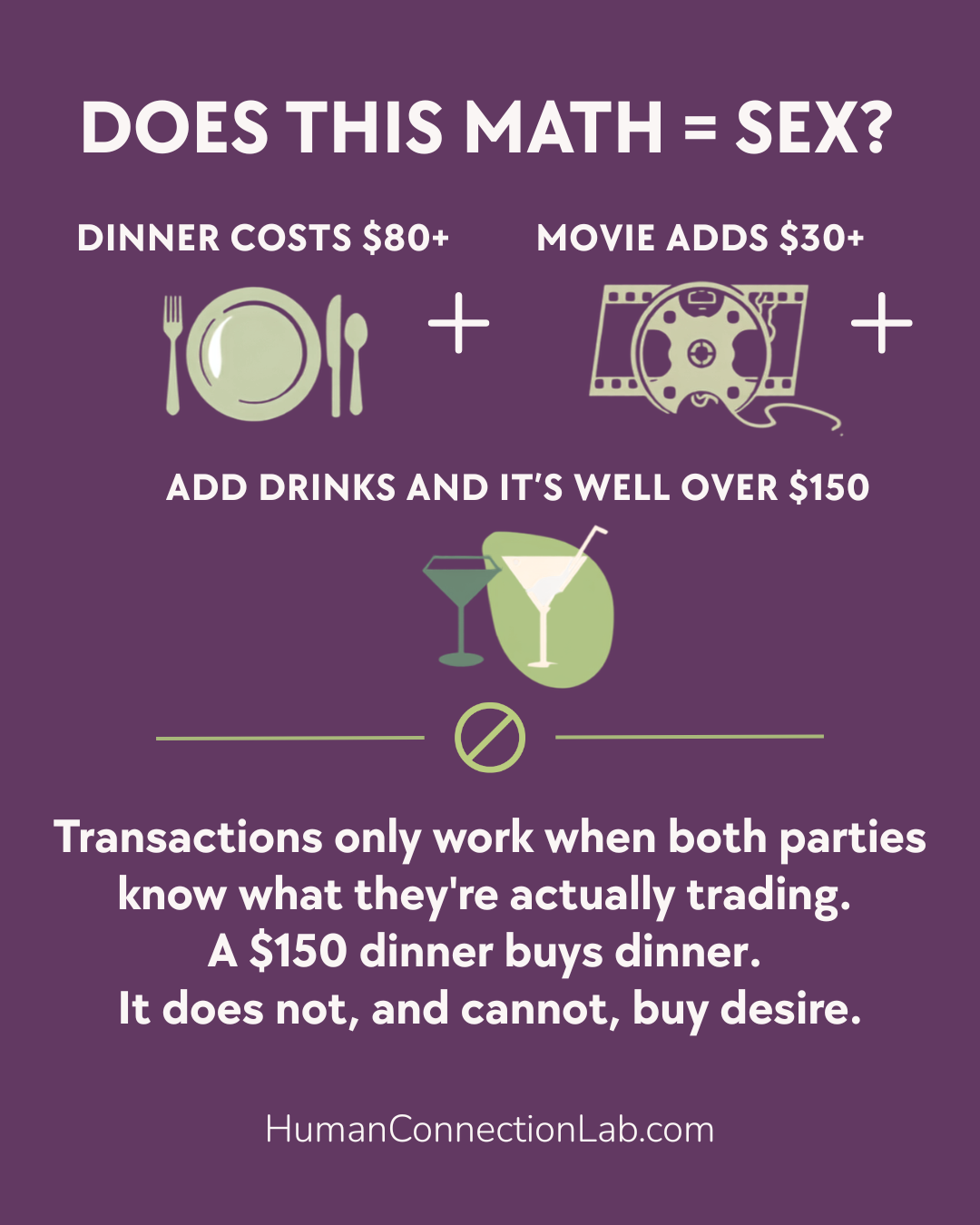
There's a quiet math a lot of men do on a date without ever saying it out loud. Dinner costs $80. A movie after adds $30. Drinks bring it to $150. And somewhere in that spreadsheet, sex becomes the expected return on investment.
It feels fair to them. Money went out, so something should come back in. That's how exchanges work, right?
Except that's not what an exchange is. That's a transaction, and transactions only work when both parties know what they're actually trading. A $150 dinner buys dinner. It does not, and cannot, buy desire. **Note: I'm a huge supporter of sex work, which by definition is consensual, trafficking is a separate and very different thing. I also firmly believe that a ton of people are doing unpaid sex work, they just don’t realize it and that’s not cool.
Where I'm Coming From
Most of my own dating and sexual history has happened in heterosexual pairings, and this post is shaped by that lens. I'm sure some version of this dynamic shows up outside of straight relationships too, people finding all kinds of ways to treat intimacy as owed rather than built. But I suspect this particular flavor, sex as a guaranteed return on a purchase, shows up more often and more deeply in heterosexual dynamics specifically, and I don't think that's a coincidence.
A lot of our cultural scripts around dating and marriage were built inside religious frameworks that already treated sex as something a wife owes a husband, something a woman gives and a man receives, packaged as duty long before anyone called it that outright. That history doesn't disappear just because fewer people are actively religious now. It's baked into the dating math whether anyone in the exchange realizes where it came from.
So take this as what it is, one woman's honest read on a pattern she's lived and watched closely, not a universal claim about every relationship everywhere.
Desire Isn't a Line Item
Desire has to be built, not purchased, and nothing about picking up a check builds it. No attunement. No slow-building charge. No curiosity about what she finds hot, what makes her feel safe enough to want more, what her body is actually signaling underneath the polite conversation.
Paying for the meal assumes the outcome. It treats sex like the thing you get for showing up and swiping the card, not something that has to be built, invited, and mutually chosen in the moment.
And when we say "what's in it for me" out loud about sex, it sounds crude. But it's the honest question a body asks. Is this going to feel good? Is this person paying attention to me, or just moving toward their own finish line? Do I trust this person with my pleasure?
If the answer to any of that is no, or even unclear, the "exchange" was never equal. One person spent money. The other person is being asked to spend her body, her arousal, and her trust, on faith that it'll be worth it.
Paying Can Mean Something, Just Not That
Paying for a date can be a genuine gesture of interest, but only when sex isn't already assumed as the outcome. Offering to cover dinner can say I want to spend time with you, I want to get to know you, I'm curious about who you are. That's a real gesture, and it's worth something.
If sex is baked in as the expected outcome from the start, the meal stops being a gesture and becomes a fee. And when a man has sex with a woman he hasn't actually built any interest in, hasn't gotten curious about, hasn't found real value in beyond her body being present, he's not really sleeping with her. He's using her as a warm body to masturbate into, and calling it a date so he doesn't have to sit with what that actually is.
That's a hard sentence to read, and it's meant to be. Because the alternative, going home and taking care of himself, was always available. Choosing her instead only means something if she was chosen as a whole person, not selected as a more convenient option than being alone.
Getting to spend time with someone who appeals to you, someone you're curious about, someone whose company you actually want, is a privilege. Not a fee you paid for. Not something owed to you because you asked first and picked up the check. A privilege, earned by showing up with real interest, not spent like currency toward a predetermined outcome.
The question worth sitting with isn't "did I pay enough to deserve this." It's simpler and harder: does she appeal to you as a whole person, or just as a hole.
The Orgasm Gap Says the Math Doesn't Check Out
The orgasm gap is the well documented, persistent difference in how often men versus women reach orgasm during heterosexual sex, and it proves the "dinner for sex" exchange was never equal to begin with. A large scale U.S. study of more than 52,000 adults, published in the Archives of Sexual Behavior, found that roughly 95 percent of heterosexual men regularly orgasm during partnered sex, compared with about 65 percent of heterosexual women. Among lesbian women, that number rises to around 86 percent, which points away from biology and toward something about how heterosexual sex tends to get approached.
That's not a biology problem. Women aren't broken. What it points to is a skills and attention problem: a lot of heterosexual sex is still built around a script where his arousal is the main event and hers is assumed, or worse, treated as an afterthought.
So when "I paid for dinner" gets treated as fair trade for sex, it's actually trading a known, guaranteed good (the meal) for an unknown, often statistically unlikely good (her pleasure). That's not balance. That's a bad deal, and she's the one being asked to accept it.
What Reciprocity Actually Looks Like
Real reciprocity means both people are building the experience together and both are accountable for whether it's working, not one person cashing in on what they spent. It isn't "I gave you X, now you owe me Y."
That means:
Desire gets built, not assumed. Attention, curiosity, and pacing matter more than the bill.
Both people get to ask "what's in it for me?" Wanting good sex isn't selfish. It's a baseline expectation, from both sides.
Consent isn't a decision made once, it's an ongoing conversation. Yes and no aren't checkboxes. They're a state of being that can shift the whole night, and that's allowed.
Pleasure gets checked on, not assumed. If one partner is consistently having a better time than the other, that's information, not a personal failing to hide.
The people I see navigating dating well aren't the ones tracking who paid for what. They're the ones who've already practiced asking "is this good for you too?" long before a check ever hits the table, and who actually know how to listen to the answer.
The Skill Gets Built Somewhere Else First
Intimacy skills like attunement and reading consent are built outside of sex, not during it, and they naturally translate once sex actually happens. Here's the part most dating advice skips: none of that is a skill you develop for the first time in bed. By the time sex is on the table, it's too late to start learning how to pay attention to another person.
That skill gets built earlier, in lower stakes places. In actual conversation where you're curious about someone's answer instead of waiting for your turn to talk. In noticing when someone leans in versus pulls back, and adjusting instead of pushing through. In non-sexual touch, a hand on a shoulder, a hug that lingers or doesn't, and learning to read what that person's body is telling you without needing it to mean more than it does.
Both sides of this get better with practice, and neither side is off the hook. She's learning to trust her own no, to notice what she actually wants instead of what she thinks she should offer for the meal. He's learning that attention paid without an agenda is what actually builds desire, not the bill.
None of that requires sex to practice. That's the whole point. You get good at reading a person, at asking, at noticing, at pacing, in contexts where nothing is riding on the answer. And then, when two people who've each done that work end up together, sex isn't a transaction anyone negotiated their way into. It's just the next honest thing, happening because it's actually wanted, not because dinner was purchased.
That's what "when it's meant to happen" really means. It’s not fate, it’s readiness.
This Math Doesn't Stop After the Wedding
The same broken exchange from dating doesn't disappear after marriage, it just becomes permanent, and that's often where sexual coercion quietly lives.
Marry the guy who paid for enough dinners, and the ledger doesn't close, it just becomes permanent. Sex stops being something built between two people and starts being something owed. A husband who believes sex is guaranteed by the relationship itself, not by ongoing desire, ongoing attunement, ongoing yes, is running the exact same math from that first date. He's just extended the payment plan to include a mortgage and a ring.
And when a wife starts treating sex as a chore, something to get through rather than something she wants, that's not a libido problem to fix with a supplement or a date night. That's the natural end point of an exchange that was never actually reciprocal. You cannot obligate someone into desire. You can only obligate them into compliance, and compliance dressed up as intimacy is where sexual coercion quietly lives, inside marriages, inside "healthy" relationships, inside couples who would be offended if you used that word about them.
Valuing sex as an act you're entitled to, instead of valuing the person and the relationship that makes wanting it possible in the first place, is the same mistake at every stage. It looks like picking up a check on a first date. It also looks like decades of a marriage where one partner stopped asking if the other still wants this, because the guarantee was assumed the day they said I do.
The skill that gets built before sex, paying attention, checking in, actually caring whether this is good for both people, doesn't get to expire once the relationship is official. It's the whole relationship. Every time.
The Real Cost of Getting This Wrong
Treating intimacy as a transaction instead of a collaboration shortchanges everyone involved, not just the person expected to deliver on the deal. When "I paid" becomes shorthand for "you owe me," it quietly teaches everyone that intimacy is something to be paid for rather than shared. That framing doesn't just shortchange women's pleasure. It also robs men of the far better experience available to them: being genuinely wanted, by someone who's actually into it, instead of settling for someone going through the motions because the check already came.
Dinner is dinner. Desire has to be earned differently, and it's a much better night for everyone when it is.
Common Questions
Is paying for a date the same as being owed sex? No. Paying for a date can be a genuine sign of interest, but it does not create an obligation for sex. Desire and consent have to be built and given in the moment, regardless of who paid for dinner.
What does sexual reciprocity actually mean in a relationship? Sexual reciprocity means both partners are equally invested in the experience being good for each other, through ongoing attention, communication, and consent, rather than one person feeling entitled to sex because of money spent, time invested, or relationship status.
Why is there an orgasm gap in heterosexual relationships? Research points to sociocultural factors rather than biology. Heterosexual sex is often scripted around male orgasm as the endpoint, while lesbian couples report far more equal orgasm rates, suggesting the gap comes from attention and approach, not anatomy.
Can this dynamic show up in marriage, not just dating? Yes. When sex is treated as guaranteed by the relationship itself rather than something built through ongoing desire and consent, it can turn into an obligation. Sex experienced as a chore or duty, rather than something genuinely wanted, is often a sign this dynamic has taken hold long term.
Has this post left you thinking?
Does this post leave you with questions about your past, your present, or your future? Michelle Renee is a Holistic Intimacy Coach who works with individuals and couples on building consent, attunement, and reciprocity in their relationships. Want to build attunement and consent skills before you need them in the moment? Book your free 20-minute consultation.